
What is Ayurveda?
Ayurveda is one of the oldest systems of medicine in the world, originating from Ancient India more than 5,000 years ago. The word Ayurveda comes from two Sanskrit words: “Ayu” meaning Life and “Veda” meaning Knowledge, which together mean “The Science of Life.”
Originally passed down as an oral tradition, Ayurveda was later recorded in Sanskrit texts known as the Vedas, including the Rig Veda, Yajur Veda, Sam Veda, and Atharva Veda. These ancient texts form the foundation of Ayurvedic knowledge and holistic health practices.
Ayurveda is not just a medical system but a lifestyle science. Its main aim is to preserve health, prevent disease, and maintain balance in the body and mind. Ayurveda focuses on understanding ourselves, our habits, and how our lifestyle influences our health and well-being.
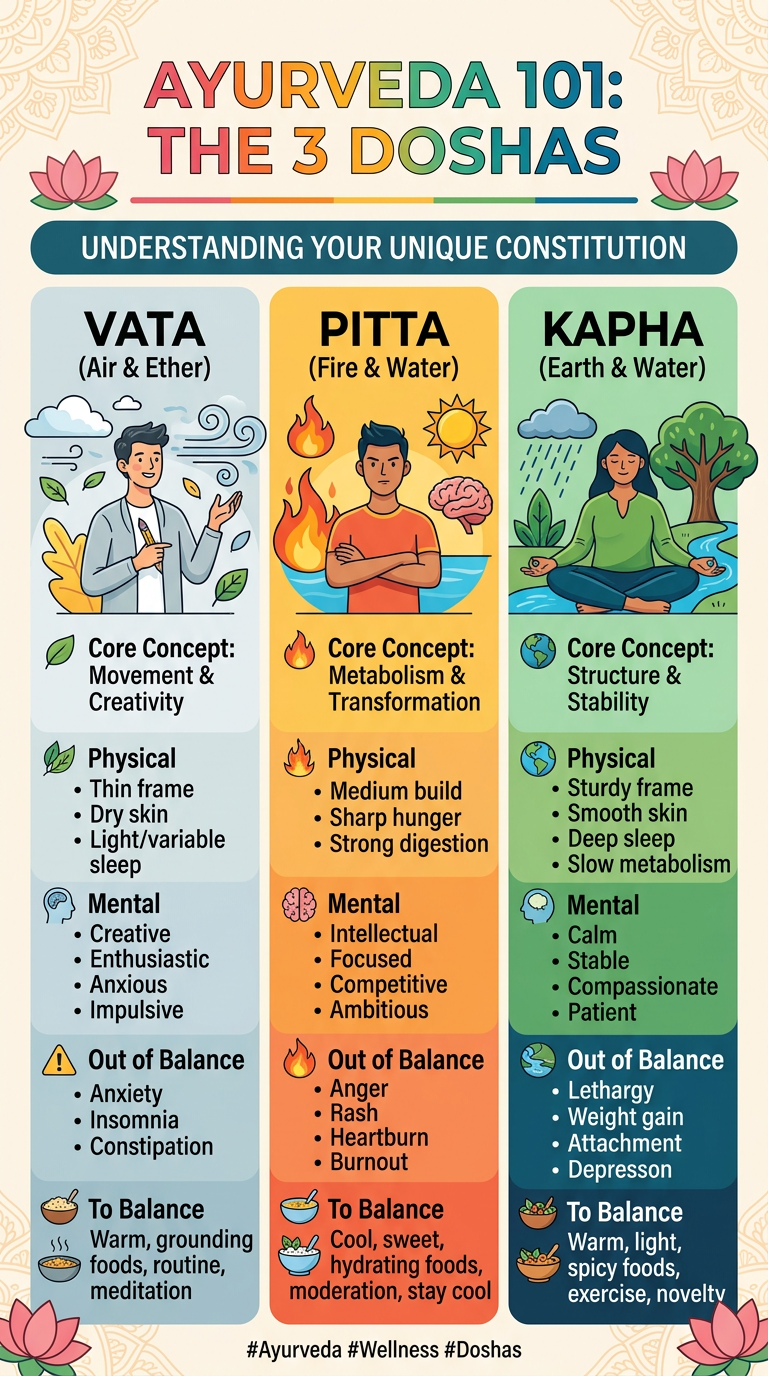
One of the most important concepts in Ayurveda is the Three Doshas: Vata, Pitta, and Kapha.
Understanding the Three Doshas in Ayurveda
Anyone who has heard about Ayurveda would have come across the terms Vata, Pitta, and Kapha. These are the three fundamental energies that govern how our body and mind function.
Just like we need good circulation, digestion, and body strength to live a healthy life, Ayurveda uses the concept of the three doshas to understand how our bodies respond to stress, environment, food, and lifestyle.
An important thing to remember is that every person has all three doshas, but in different proportions. Health in Ayurveda means keeping these three doshas in balance.
Let’s explore each dosha in more detail.
Vata Dosha (Air & Space): The King Dosha of Movement
Vata Dosha represents the air and space elements and governs all forms of movement in the body and mind. It is often described as the wind that moves clouds in the sky. Vata is cool, light, dry, mobile, and subtle.
Vata is known as the King Dosha because it is responsible for movement. Without movement, nothing in the body or mind can function properly.
Vata in the Body
In the body, Vata controls:
- Nervous system
- Movement of muscles
- Breathing
- Blood circulation
- Blinking of eyes
- Chewing and swallowing
- Elimination of waste
- Menstrual flow
- Childbirth
Vata in the Mind
In the mind, Vata is associated with:
- Thoughts and imagination
- Anxiety and fear
- Creativity
- Short-term memory
- Excitement and enthusiasm
- Overthinking and restlessness
Vata in Personality
People with strong Vata qualities are usually:
- Creative
- Expressive
- Energetic
- Curious
- Adventurous
- Social
- Sometimes impulsive or forgetful
When Vata is balanced, a person feels creative and energetic. When Vata is imbalanced, it may lead to anxiety, fear, insomnia, dry skin, constipation, and restlessness.
Pitta Dosha (Fire & Water): The Energy of Transformation
Pitta Dosha represents the fire and water elements and governs transformation, digestion, metabolism, and processing in the body and mind. It is the fire that transforms food into energy and information into knowledge.
Pitta is hot, sharp, oily, intense, and penetrating.
Pitta in the Body
In the body, Pitta controls:
- Digestion
- Metabolism
- Body temperature
- Liver function
- Enzymes and hormones
- Nutrient absorption
Pitta is especially active in the stomach, liver, and small intestine.
Pitta in the Mind
In the mind, Pitta is associated with:
- Focus and concentration
- Intelligence
- Planning and organization
- Anger and frustration
- Determination
- Analytical thinking
This is sometimes called “Thought digestion” because Pitta processes information and converts it into understanding and knowledge.
Pitta in Personality
People with strong Pitta qualities are usually:
- Focused
- Organized
- Intelligent
- Goal-oriented
- Confident
- Good leaders
- Efficient and productive
When Pitta is balanced, a person feels confident and focused. When Pitta is imbalanced, it may lead to anger, irritability, acidity, skin issues, and inflammation.
Kapha Dosha (Earth & Water): The Energy of Stability and Longevity
Kapha Dosha represents the earth and water elements and governs structure, stability, lubrication, and nourishment in the body and mind. Kapha is the heaviest and most stable of the three doshas.
Kapha is associated with strength, stability, immunity, and longevity.
Kapha in the Body
In the body, Kapha controls:
- Body structure
- Muscles and tissues
- Bones and joints
- Hydration
- Immunity
- Skin and hair health
- Strength and stamina
Kapha provides stability and nourishment to all tissues.
Kapha in the Mind
In the mind, Kapha is associated with:
- Calmness
- Patience
- Long-term memory
- Emotional stability
- Deep sleep
- Relaxation
- Compassion
Kapha in Personality
People with strong Kapha qualities are usually:
- Calm
- Stable
- Loyal
- Patient
- Strong
- Slow and steady
- Supportive and caring
When Kapha is balanced, a person feels calm and stable. When Kapha is imbalanced, it may lead to lethargy, weight gain, slow digestion, excessive sleep, and low motivation.
The Balance of the Three Doshas
The three doshas are always interacting with each other to maintain:
- Nervous system function
- Digestion and metabolism
- Body structure and immunity
- Mental and emotional balance
When Vata, Pitta, and Kapha are balanced, a person experiences good physical, mental, and emotional health.
When the doshas become imbalanced, it may lead to:
- Digestive issues
- Constipation
- Lethargy
- Irritability
- Sleep problems
- Anxiety
- Difficulty concentrating
- Low immunity
- Skin issues
- Hormonal imbalance
Ayurveda focuses on restoring balance through diet, lifestyle, sleep, routine, herbs, yoga, and detox therapies.
The Three Pillars of Health in Ayurveda
Ayurveda says that health depends on three main pillars:
- Food (Ahara)
- Sleep (Nidra)
- Lifestyle / Daily Routine (Brahmacharya or Vihara)
When these three pillars are balanced, health improves naturally.
We will explore these three pillars in the next article
Written by Parnella Rayappan